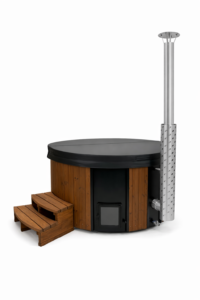
At a glance, many wood-fired hot tubs look the same. The wood finish, the round shape, the chimney rising from the side — visually, a €3,500 tub and a €7,000 tub can be hard to tell apart. The differences live underneath, where buyers can't see them — and where most failures begin.
This guide covers the seven factors that separate a hot tub built to last 15 years from one that will quietly deteriorate within five. Each one is something you can verify directly with the manufacturer before you buy. If a seller can't answer these questions with specifics, that's information too.
The single most important specification on a wood-fired hot tub is one most buyers never ask about: what grade of stainless steel is the stove made from?
AISI 304 is the most common grade of stainless steel worldwide. It's cheap, easy to source, and entirely appropriate for indoor kitchen equipment, food processing, and dry environments. In a hot tub stove — exposed permanently to outdoor weather, repeated heating cycles, condensation, and chemically treated water — it corrodes faster than buyers expect. Visible rust within 3–5 years is common.
AISI 316, also called marine-grade stainless steel, contains 2–3% molybdenum that 304 doesn't. That additive dramatically improves resistance to corrosion in humid, salt-exposed, and chemically aggressive environments. It's the grade used in shipbuilding, offshore platforms, and coastal infrastructure for exactly this reason.
The cost difference between 304 and 316 at manufacturing is roughly 30%. Some manufacturers pass that saving to you. Most pocket it. Either way, the buyer pays for it later — in stove replacements, service calls, and reduced lifespan.
Ask the manufacturer for the AISI grade of the stove in writing. A serious manufacturer answers with a specific number. Vague answers like "high-quality stainless" or "premium stainless" usually mean 304.
"What grade of stainless steel is the stove made from? Is it marine-grade?"
For a deeper technical breakdown, see our full comparison of AISI 304 vs 316 stainless steel.
The stove door is one of the most stressed components in the entire tub. It expands and contracts every time you light a fire, then cools as the session ends. Over the years, this thermal cycling accumulates — and the material the door is made from determines whether the door still seals correctly a decade later, or whether it has warped enough to leak heat and reduce combustion efficiency.
Thin stainless steel doors are common in budget models because they're cheaper to manufacture. They typically warp within 2–3 years of regular use. A warped door means an uneven seal, reduced burn efficiency, and visible deformation that becomes worse with each season.
Cast iron doors behave differently. The material's thickness and structural rigidity make it highly resistant to warping under repeated heat cycles. Cast iron is the standard material for premium wood-burning stoves for the same reason it's used in cookware: it tolerates extreme temperature changes without losing its shape.
Ask whether the stove doors are cast iron or thin stainless steel. Cast iron is significantly more durable for long-term outdoor use and worth checking specifically.
"Are the stove doors cast iron, or stainless steel sheet?"
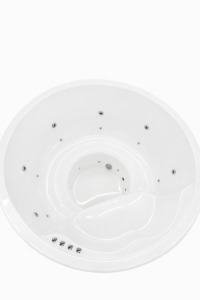
The fiberglass insert is the bath you actually sit in. It's also the component most often compromised on cheap models — for a simple reason: thinner fiberglass costs less, and the difference isn't visible until years later.
An undersized fiberglass shell flexes slightly under load — under the weight of water, under the weight of bathers, under repeated heat cycles. Flexing leads to stress marks, surface fatigue, hairline cracks at edges, and eventually structural cracking. Once a fiberglass insert cracks, repair is rarely permanent. Most buyers in this situation replace the tub.
Premium inserts are reinforced and produced with significantly greater wall thickness. Bauqua's inserts are 50% thicker than the industry standard, with structural reinforcement designed for permanent outdoor use under heavy load.
The thickness specification isn't always advertised on product pages — but it's a question a manufacturer should be able to answer immediately. If they can't, that tells you something.
Ask for the fiberglass insert thickness specification. Whether the answer is in millimetres or as a comparison to "industry standard," the manufacturer should be able to give one. A manufacturer who can't quantify their insert thickness is one who hasn't designed for it.
"How thick is the fiberglass insert? Is it reinforced?"
Insulation is the spec that determines how much firewood you'll burn over a decade of ownership — and how comfortable the tub will be on the coldest evenings of the year.
A poorly insulated hot tub loses heat through three places: the water surface (controlled by the lid), the side walls (controlled by the wall structure), and the base (controlled by the foundation and base materials). On a cold evening, an uninsulated tub can lose 5–8°C overnight even with the lid closed. A well-insulated tub holds heat for significantly longer, which translates directly to faster reheat times and reduced firewood consumption.
The most important insulation elements:
Manufacturers who take insulation seriously will mention specific materials and thicknesses. Manufacturers who use minimal or no insulation rarely advertise the fact — they describe the tub as "thermally efficient" without specifics.
Ask what insulation materials are used in the lid, walls, and base. The answer should reference specific materials — polyurethane foam, insulated thermo lid — not vague "good insulation."
"What's between the fiberglass insert and the outer wood? Is the lid insulated?"
This is where the wood-fired hot tub market plays its biggest pricing game — and where buyers most often get misled by an attractive base price that quietly excludes most of what they need.
It's common to see a "complete" hot tub advertised at €4,500, only to discover that the price doesn't include:
By the time the customer adds everything they actually expected, the "€4,500 tub" has become €6,000–€7,000 — often more expensive than competitors who included these items in the original price.
The Bauqua Amber 200 (€5,900) and Amber 225 (€6,700) include all the above as standard. No upsell at checkout. No surprise components. You see the full price upfront.
Before comparing prices between manufacturers, request a complete itemised list of what's included. Then add the cost of any missing components to get the real comparison price.
"Is this the full price for everything, or are there accessories that cost extra?"
The base of the hot tub — the part that sits on your foundation and supports the entire structure — is invisible once installed. It's also the component most likely to fail first in cheap models, and it's the question almost no buyer thinks to ask.
Many low-cost wood-fired hot tubs use timber bases: wooden beams or panels that support the fiberglass insert from below. Wood is cheap and easy to manufacture, but in the permanently damp, condensation-rich environment under a hot tub, it rots. Buyers who choose wooden-base tubs often report structural sagging or visible rot within 5–7 years. Once the base begins to fail, the entire tub becomes unstable — and the repair typically isn't worth the cost.
Some manufacturers use plastic bases. These don't rot, but plastic flexes and degrades under UV exposure and repeated weight loads. They're better than wood but not built for long-term reliability.
Stainless steel structural bases are the standard for premium tubs. They don't rot, don't flex meaningfully under load, and remain stable through freeze-thaw cycles for the lifetime of the tub. Bauqua uses AISI 304 stainless steel for the structural foundation across all Amber models — the same material used for kitchen-grade industrial equipment.
This single specification is often the difference between a tub that survives 15 years and one that fails at year 6.
Ask specifically what material the structural base is made from. The answer should be stainless steel. Wood is a long-term liability. Plastic is acceptable but not ideal.
"What's the base structure made of — wood, plastic, or stainless steel?"
A warranty is the single clearest indication of how much the manufacturer expects their own product to fail. It's also the most underused tool in pre-purchase research — most buyers never read warranty terms until something has already broken.
Three things to look at, in order of importance:
Premium wood-fired hot tub manufacturers offer warranties ranging from 2 to 5 years on manufacturing defects. Anything shorter than 2 years suggests low confidence in long-term reliability. Bauqua provides a 2-year warranty on manufacturing defects and major functional issues across all Amber models — including stove malfunctions, structural damage, and cracks in the fiberglass insert under normal use.
This is where the language becomes important. Some warranties cover "the hot tub" but exclude the stove. Some cover the wood structure but exclude the fiberglass insert. Read the actual coverage list — not just the headline number.
A serious manufacturer covers the components most likely to fail: stove, structural frame, and fiberglass insert. Cosmetic changes, natural weathering, and damage from improper use are reasonable exclusions. Excluding the stove from warranty coverage is not — the stove is the part that does the actual heating work.
Read the exclusions list. Standard exclusions include cosmetic wear, weather discoloration of wood, and damage from freezing water left in pipes. Unusual exclusions — like "stove components" or "electrical fittings" or "anything used in salt-air environments" — tell you what the manufacturer expects to fail and doesn't want to be liable for.
Request the full warranty terms document before purchase, not just the length. Check what's covered, what's excluded, and how a claim is actually handled. A manufacturer who is confident in their product makes warranty terms easy to find.
"Can I see the full warranty terms in writing before I order?"
Each of these seven checks individually filters out a few weak manufacturers. Together, they filter out almost all of them.
A buyer who asks all seven questions before purchase is taking 15 minutes of conversation to avoid 5–10 years of regret. A manufacturer who can answer all seven with specifics is one who has thought about the long-term product, not just the sale.
The price difference between a 5-year tub and a 15-year tub is rarely more than 30%. The difference in lifetime cost of ownership is much greater.
Premium isn't about polish or marketing. It's about whether the parts of the tub you can't see have been built to the same standard as the parts you can.
Copy these to your phone, email, or call with any wood-fired hot tub manufacturer. Direct, specific answers indicate a serious manufacturer. Vague answers indicate a sales pitch.
AISI 316 marine-grade stove. Cast iron doors. Reinforced fiberglass insert 50% thicker than standard. Stainless steel structural foundation. Full equipment included in the price. 2-year warranty on manufacturing defects. Direct from the workshop in Lithuania.

Erzähl uns von deinen Plänen, und wir erstellen eine persönliche Empfehlung.
Wir antworten in der Regel innerhalb von 24 Stunden.
Tell us about your plans and we will prepare a personalised recommendation.
We typically respond within 24 hours.
Tell us about your plans and we will prepare a personalised recommendation.
We typically respond within 24 hours.